The Last Post Fades, the Waiting Lists Don't: Veterans' Support in Bridgend This Winter
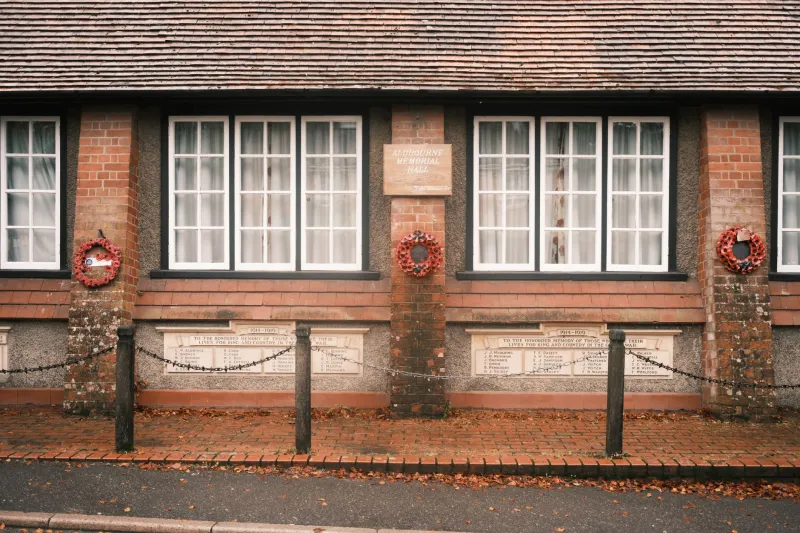
By ten o'clock this morning the pavement outside the memorial in Bridgend town centre was already crowded, and much the same scene was repeated in Maesteg, Porthcawl, Pencoed and the valley communities that make up this constituency. Standards were lowered, wreaths were laid, and the Last Post sounded across a cold, bright November morning.
Remembrance Sunday does something important. It insists that the country stops, if only for an hour, and looks squarely at what service costs. What it cannot do is settle the account. The parade is finished by noon. The referrals, the housing decisions and the compensation claims carry on into Monday morning — and it is there, in the casework rather than the ceremony, that the promises made to veterans are actually tested.
The morning is the easy part
The weeks after Remembrance Sunday reliably bring a particular kind of enquiry to my office. They are rarely dramatic. They are the ordinary mechanics of a state that has not joined its own systems up: a referral that was made and never arrived, a form that asked for a document nobody possesses, a decision that turned on a rule the applicant had never heard of.
These are not failures of goodwill. They are failures of design, and they are fixable. But they will not be fixed by another wreath.
Three cases from the winter postbag
All three are anonymised, and some details have been changed to protect the individuals concerned. The pattern they describe is not unique to them.
The sapper in the Llynfi Valley. A former Royal Engineer in his early forties, who left the Army in 2019 after two operational tours, was referred by his GP to Veterans' NHS Wales in January. His first appointment came in the autumn. In the intervening months there were two attendances at an emergency department and a period of signed-off work that his employer handled with real patience. The clinical care, once it arrived, was excellent. The wait was not care of any kind, and it is where the money is quietly spent instead.
The couple in Porthcawl. A veteran and his partner left the Royal Air Force in 2024 after sixteen years, the last eight of them in service accommodation. They returned to the town where his mother lives and applied for social housing. They were asked for a tenancy history they could not produce, because their homes had belonged to the Ministry of Defence, and were placed in a band that reflected an absence of paperwork rather than an absence of need.
The claim in Brackla. A younger veteran submitted a claim under the Armed Forces Compensation Scheme in late 2025. Eleven months on, there had been no decision and no named caseworker. In the meantime he is on Universal Credit, and the delay in compensating an injury has become a delay in everything else: a deposit, a car, a course.
What the Covenant actually promises
The Armed Forces Covenant is often described as a promise that those who serve will be treated fairly. Since November 2022, the Armed Forces Act 2021 has placed a duty on specified public bodies in housing, education and healthcare to have due regard to the Covenant when carrying out certain functions.
It is worth being precise about what that means, because both over-claiming and under-claiming are common. The duty is not a right to jump a queue, and it is not a guarantee of a service. It requires decisions to be taken with the needs of the armed forces community consciously in mind. Where special treatment is justified — for example, where service accommodation leaves a gap in a housing history — the duty is intended to make that treatment possible.
That is a testable standard. If a housing officer never asks the question, the duty has not been performed, whatever the policy document says.
Who holds which lever
Veterans' policy in Wales is split across four sets of hands, which is the root of much of the frustration in my postbag.
- The Welsh Government controls the NHS in Wales, including Veterans' NHS Wales and its regional teams, along with housing, homelessness, education and the funding that pays for council services.
- The UK Government controls defence, Veterans UK (war pensions and the Armed Forces Compensation Scheme), DWP benefits, the Office for Veterans' Affairs and the Covenant Fund. Its responsibility for NHS mental health services for veterans, through Op COURAGE, stops at the border.
- Cwm Taf Morgannwg University Health Board controls GP referral routes and waiting times for psychological therapies in this area.
- Bridgend County Borough Council makes the housing allocation and homelessness decisions, and is itself a Covenant signatory.
Because no single body owns the whole journey from discharge to settled life, no single body is answerable when that journey stalls. That is a structural flaw, not a personal one.
What I am asking for
Four practical changes would make a measurable difference within a year.
- The Welsh Government should publish referral-to-treatment times for Veterans' NHS Wales, broken down by health board, so that waits can be seen and managed rather than endured.
- The UK Government should publish quarterly timeliness data for the Armed Forces Compensation Scheme and allocate a named caseworker to every claim outstanding beyond eight weeks.
- Bridgend County Borough Council should adopt a written armed forces housing protocol, with a named lead officer, that sets out how service accommodation is treated as tenancy history.
- The health board should establish a single, published referral route into veterans' psychological services, so that a GP in Maesteg and a GP in Porthcawl are working from the same map.
Where to get help this winter
- Veterans' NHS Wales — self-referral or through a GP; the regional team covers the Cwm Taf Morgannwg area.
- SSAFA — practical support, casework and mentoring for serving personnel, veterans and families.
- Royal British Legion — benefits and money advice, including help with Armed Forces Compensation Scheme claims.
- Change Step — Welsh peer-mentoring and support service for veterans and their families.
- Veterans UK — war pensions and compensation, on 0808 1914 2 18.
- Combat Stress — 24-hour helpline on 0800 138 1619.
- Citizens Advice Bridgend — debt, benefits and housing advice for anyone in the constituency.
My own surgeries continue through the winter, and my office will pursue a case with any of the bodies listed above where a constituent has hit a wall. No one should have to work out which of four governments to telephone.
The wreath is laid. The debt is not discharged by two minutes of silence, and the men and women who marched this morning deserve a country that is as organised in the other 364 days of the year as it is on this one.